
Original vs Print Artwork
How to tell if your artwork is an original or a print
Many artworks that look hand-painted are actually reproductions, and some originals can appear smooth. Knowing whether you have an original painting or a fine art print can mean the difference between a $500 piece and a $50,000 one. Upload your artwork anytime for a free valuation and originality check.
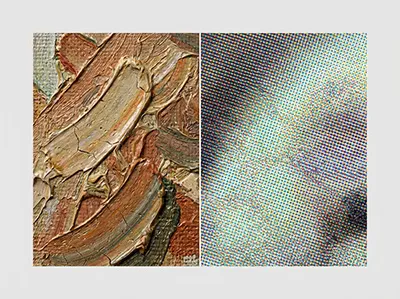
Original vs print at a glance
Original artwork
Created directly by the artist's hand — one of a kind. Oils, acrylics, watercolors, drawings, mixed-media, and hand-pulled prints all qualify.
- Visible texture, brushwork, and layered paint
- Variations in color and pressure
- No edition numbers (hand-pulled prints are an exception)
- Surface irregularities hard to replicate
Reproduced from an original — exists in multiples. Ranges from valuable fine art editions to mass-produced reproductions and decor.
- Uniform surface, often smooth or mechanically textured
- Dot patterns visible under magnification
- Edition numbers (23/100, A.P., H.C.)
- Printed or flat signatures
How to tell if a painting is original or a print
You can often determine whether a piece is an original or a reproduction print without leaving your home. These six checks work for oil paintings, acrylics, watercolors, and works on paper. If you've inherited artwork or found a piece at an estate sale, start here before assuming it's valuable — or worthless.
Look at the surface texture
Original paintings show thick strokes, uneven paint, layered areas, knife marks. Prints and reproductions show uniform or printed texture; giclées may fake brushwork but lack changing direction/thickness under magnification.
Examine the edges
Canvas originals often wrap paint around edges with splashes or imperfections. Prints on canvas tend to have clean, uniform edges and full-bleed images.
Check the signature
Hand-signed marks show indentations and texture variations. Printed signatures look flat and identical across copies. Signatures alone don't prove originality—prints can be signed.
Look for edition numbers
23/100, A.P., H.C., P.P. indicate a print or fine art edition—not a hand-painted one-off.
Use phone zoom to check for dots
Modern prints reveal dot matrices or repeating patterns. Originals show irregularities, not uniform dots.
Check the back
Original canvases show stretcher bars, staples, age, gallery labels. Prints on canvas may look machine-stapled and clean. Paper originals can have deckled edges, watermarks, embossed printer marks.
Print types explained
Not all prints are created equal. Fine art prints can be worth tens of thousands, while poster prints and mass-produced reproductions have little resale value. Understanding the printing method helps you estimate where a piece falls on that spectrum.
Lithographs
Created using a chemical process on stone or metal plates, lithographs produce smooth, consistent ink coverage with subtle grain patterns. They can be original artist lithographs (where the artist drew directly on the plate) or photomechanical reproductions. Signed and numbered lithographs by artists like Chagall or Miró can be quite valuable; unsigned reproductions typically are not.
Serigraphs (silkscreens)
Ink is pushed through a mesh screen to create bold, layered colors — the technique Warhol made famous. Serigraphs often have slight texture from the ink buildup and are typically produced in limited editions. Signed screenprints by notable artists regularly sell for $5,000–$50,000+ at auction.
Giclée prints
High-resolution inkjet prints on canvas or archival paper, giclées reproduce color accurately but show dot patterns under magnification. Most are decorative reproductions with minimal resale value. The exceptions are signed, limited-edition giclées by contemporary artists, which can carry modest value — but far less than original work.
Offset reproductions
Mass-produced poster prints created for home decor, often sold in furniture stores and big-box retailers. These have very smooth surfaces, printed (not hand-signed) signatures, and no edition numbers. Resale value is negligible regardless of the image — they're manufactured in the thousands.
Hand-pulled prints (etchings, engravings, woodcuts)
Etchings, engravings, woodcuts, linocuts, mezzotints, and drypoints are considered original prints because the artist physically creates each impression from a plate or block. These are highly collectible, especially from old masters and established 20th-century printmakers. Condition and edition size significantly affect value.
How to tell if a print has value
Not all prints are worthless reproductions — some fine art prints sell for more than original paintings by lesser-known artists. These factors separate a valuable art print from mass-produced decor.
Limited editions
Smaller editions are more desirable. An edition of 50 creates genuine scarcity; an edition of 500 does not. Edition size directly affects price — a Warhol from an edition of 250 will sell for less than one from an edition of 50, all else being equal.
Signed by the artist
A hand signature (pencil on paper, ink on the image) adds significant value, even on prints. The signature should show indentation or ink variation — not a flat, printed reproduction. Signed prints can be worth 2–10x more than unsigned impressions from the same edition.
Artist proofs (A.P.)
Artist proofs are a small group of prints reserved for the artist, outside the numbered edition. Because they're scarcer (typically 10–15% of the main edition), A.P. prints often command a premium. Look for "A.P." or "E.A." (épreuve d'artiste) in pencil below the image.
Renowned publishers and ateliers
A blindstamp or chop mark from a respected print workshop adds provenance and value. Names like Mourlot, Gemini G.E.L., Tyler Graphics, and Atelier Crommelynck signal quality. If you're planning to sell artwork with such marks, mention them — collectors look for them.
Why originals are usually worth more than prints
Originals are one-of-a-kind. Collectors pay for rarity, direct connection to the artist, and uniqueness. Prints, even valuable ones, exist in multiples.
Auction records consistently show that original paintings and drawings outperform prints by the same artist. Provenance, exhibition history, and the irreplaceable nature of a unique work all drive collector premiums — especially for established names.
That said, some prints exceed the value of lesser-known originals — screenprints by Warhol or Haring often sell for more than paintings by lesser-known artists. The market decides value, not the medium alone.
⚠ Common misconceptions about originals vs prints
- "If it has texture, it must be original." (Faux texture coatings exist.)
- "If it's signed, it must be valuable." (Many prints have printed signatures.)
- "Old artwork is always valuable." (Most old prints were mass-produced.)
- "23/500 means it's rare." (500 is a large edition.)
- "A certificate guarantees authenticity." (Only if issued by a reputable source.)
When you should get a professional valuation
Not every piece needs a professional opinion, but certain signs suggest the effort is worthwhile. If your artwork shows any of these characteristics, it's worth getting a valuation before making decisions about selling, insuring, or donating.
- A signature you can't identify
- Low edition numbers (under 100)
- High-quality printing with rich colors
- Thick or unusual textures that feel hand-applied
- Gallery labels, exhibition stickers, or auction house marks on the back
- Bold colors and clean registration (colors align perfectly)
- Large dimensions (over 24" in either direction)
If you're unsure, upload photos and we'll help determine whether it's an original or a reproduction print — and what that means for value. You can also start with a free art appraisal to understand your options before deciding to sell.
Get Free ValuationFAQ: Original vs print artwork questions answered
Common questions about determining whether artwork is original or a reproduction, and what that means for value.
Check the surface texture, look for edition numbers, examine the signature, and inspect the edges and back. Original paintings show unique physical characteristics — visible brushstrokes, paint buildup, and surface irregularities that are impossible to replicate mechanically. Prints, even high-quality ones, reveal dot patterns under magnification. If you're still unsure after checking, upload photos for a free valuation and we'll help identify what you have.
Absolutely — some fine art prints sell for hundreds of thousands of dollars. Limited editions, hand-signed prints, artist proofs, and prints by famous artists like Warhol, Picasso, and Lichtenstein can be highly valuable. The key factors are edition size, signature, condition, and the artist's auction history. Mass-produced poster prints and open editions, however, have minimal resale value.
No — medium matters. Watercolors, graphite drawings, pen-and-ink works, and some acrylic paintings can be very smooth. Don't assume a flat surface means it's a print. Look for other signs: hand-applied signature, lack of edition numbers, and unique irregularities that wouldn't appear in a mechanical reproduction.
It's an edition number indicating this is the 23rd impression out of a total edition of 100. The first number is the print number; the second is the edition size. Smaller editions (under 100) are generally more desirable than large ones (500+). Edition numbers are typically written in pencil below the image, along with the artist's signature.
Artist proofs are a small group of prints — usually 10–15% of the main edition — reserved for the artist's personal use or sale. They're marked "A.P." or "E.A." (épreuve d'artiste) instead of a number. Because they're scarcer than the numbered edition, artist proofs often command a premium, sometimes 20–50% higher than equivalent numbered impressions.
A printed (mechanically reproduced) signature generally indicates a mass-produced reproduction, not a fine art print. These carry minimal resale value regardless of the image. Hand-signed prints — where the artist physically signed each impression in pencil or ink — are far more valuable. You can usually tell the difference: hand signatures show pressure variation and sit on top of the paper surface.
Yes — especially if it's signed, numbered, or by a recognizable artist. Some prints are worth thousands or tens of thousands of dollars. A valuation confirms whether you have a collectible fine art print or a decorative reproduction, which determines whether it's worth selling through auction or gallery channels versus simply keeping or donating.
Ready to know if it's original or a print?
Upload photos now and receive a free research-backed estimate.
Get Free Valuation